Saturday, 11 December 2010

MOZAMBIQUE SPITTING COBRA


When I came across this Mozambique spitting cobra it was head to head with a hamerkop in the near empty swimming pool at the lodge. The bird was after the tadpoles and the snake after the toads.
It can get out of the pool by climbing the ladder but I put a log into the pool for it to use to climb out of the pool. The workers came to see the snake and most were petrified by it. They say they are evil? This one was around 5 feet long so it must have been about fully grown and in really good condition. Other snakes I have seen recently are the Rhombic night adder, the spotted bush snake, python and the striped bellied sand snake.
I decided to remove the snake from the pool last night as the water was quite cold and I had a feeling that the night watchman was going to kill the snake. I got quite a long stick and gently removed the cobra onto the grass beside the pool. I have never seen a Malawian run so fast! The snake disappeared in one direction and the man in the other.

Wednesday, 8 December 2010

LIFE GOES ON IN PARADISE

The rains are really setting in here now and the dambo is filling up again. This is good for the wildlife as it means they can find clean water everywhere however it is bad for animal viewing because it is difficult to get around the park and also means that the under growth is growing fast. A lot of animals that have been hiding under ground come out when the rains come so I expect to see spiders, frogs and snakes over the next few weeks.
The land rover is running well however when I did the shopping yesterday, 130km round trip, there was no fuel in town. How people make a living out here I don’t know as it can be very difficult to travel.
The solar panel for my electricity is ok but when the clouds come and it rains it doesn’t charge up the battery for the computer or camera batteries and although there is loads of water in the dambo the solar pump doesn’t work efficiently so the main storage tanks are low so there is a shortage of water to the houses. This also means the shower doesn’t work due to lack of water and wouldn’t be hot anyway due to lack of sun shine.
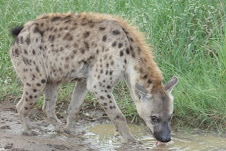
I have recently got more pictures of another leopard and also hyenas whose home ranges are about 30 km from the other leopards and hyenas that I have encountered. There have been no new sightings of the wild dogs and no reports of lion or cheetah anywhere.
The civet, bush pig and hippo turn up on my cameras regularly and last week, after trying to get his picture for 3 weeks, I finally got a video of the water mongoose that scours the fringes of the dambo most nights.
Yesterday one of the young fish eagles got a bit close to the water, while fishing, and ended up having to swim to the shore. The spur winged geese that where close by saw this as an opportunity for revenge and chased him across the lake. I am not quite sure what they would do if they really wanted to impose some damage upon him.

LICHTENSTEIN'S HARTEBEEST AND ROAN


Fairly close to the lodge you can often see small herds of roan and some of them are in really good condition. In the same area there is also a small herd of Lichtenstein’s Hartebeest. These HARTEBEEST are very rare throughout Africa.

PARADISE FLYCATCHER


I managed to get some really good photos of the paradise flycatcher making their nest near to one of the houses. This is the male building the nest. Also close to the lodge there is a nest with 2 chicks in. It looks like the mother feeds the chicks as the father cannot be seen.

STORY OF THE MATONDO


STORY OF THE MATONDO (Mopany Worm)
The moths that lay these eggs are 2 of the emperor moths. Shortly after laying several hundred eggs they hatch into caterpillars as seen below. The green caterpillar is locally caleed the Matondo and the spiky one is called the Vilungulungu. These grow incredibly quickly and can strip a 5 metre Julbernadia Globiflora tree of all of its leaves in a day. The local people from the camp and the local villages are allowed to harvest these caterpillars and in one day alone they collected in the region of 25,000kg. The caterpillars are placed in water for a couple of hours to kill them and then their insides are squashed out of them. If they are dried whole they are very bitter. They are then washed again and boiled until they change colour. They are then placed in the sun on mats to dry and then they can be eaten. Most will be re-cooked as a relish. Many of the dried caterpillars can be found for sale in the local market and can fetch about MK100 (40p) per cup full.
The darker and spiky caterpillars are considered more of a delicacy as most people don’t like collecting them because of their spikes.
Although a rough idea of numbers of the caterpillar collected are known the environmental impact has never been estimated. There are millions of caterpillars left each year to turn into moths and the trees do not seem to be damaged as they flourish in the park.

The other evening I had around 30 of the moths flying around in my house and most evenings I get various types of praying mantid, beetles, moths and stick insects. There are several geckos that run around all night long eating the smaller flies. It is fascinating to see then run across the ceiling. At the same time a large toad came visiting who presumably wanted to join in the feast. In the morning most are dead so I need to sweep up.