EXECUTIVE SUMMARY
The Malawi Government’s own park plans report that there are no carnivores in Kasungu and prey species are low because of frequent illegal poaching and encroachment.
Malawi is the tenth poorest nation in the world: its GDP per capita is $170 a year. It has a life expectancy of under 40 years. Between 10% and 13% of the 14m population suffer from HIV/AIDS. However, the population is rising by 3.5% a year. By 2050 UN estimates the population will be around 31m. Over 85% of the population live in rural village communities and food security remains top government and donor priority.
Due to the cost constraints put upon the project certain aspects of the project were not effectively covered in any detail. The survey of local communities was not followed as several villages had already been surveyed last year. Scout training was also not continued in any depth.
The objectives of this project are to carry out a pilot survey on carnivores and other wild life using various techniques including passive infra red motion sensor cameras, road side observations and walking transects. To make joint patrols and transects of Kasungu National Park with park personnel to find and record data on mammal species. To train scouts in recognition and distribution of relevant animals, spoor and other signs and to increase the national and international importance of Keystone Species of mammals in Malawi.
The cameras were positioned on well known game trails in various locations throughout the park and monitored at regular intervals. Images were then down loaded onto the computer where the results are studied. Somewhere in the region of 30,000 images were taken. Obviously not all of these captured animals and sometimes only movement of the trees and grasses. Data sheets were made of key species and individuals identified.
Walking transects were to determine species of wild life through their spoor.
Road side transects were covered in the land rover as this meant greater distances could be covered and in relative safety. Around 3226 kms were recorded during the survey with 1022 animals being seen during 293 recorded drives. During 70 drives no wild life was seen.
The most exciting news is that we discovered 2 separate packs of painted dogs. One pack on the 30 October 2010 consisted of 17 dogs, 7 adults and 10 puppies. These looked to be in very good condition. The main concern for this pack was that they were seen close to the boundary of the park to the east. If they left the park there could be conflict with the villagers which could result in their deaths. On the 11 February another pack of 9 dogs were seen and from the photographs taken and studied they were different to the first pack seen.
A small pride of 5 lions were reported in October and this consisted of 1 male, 3 female and a cub. No spoor or calls were reported throughout the whole time of the survey.
Leopard are seen and heard frequently and although mistaken for other animals by the locals the photographic survey identified at least 5 individual leopards at different locations throughout the park.
Many hours and kilometers were spent looking in areas of the park where cheetah were once known to live however no spoor was found. The only evidence of cheetah is a set of foot prints found in 2009. We are trying to setting up a work shop to discuss the possible re introduction of cheetah too Malawi with various groups from southern Africa.
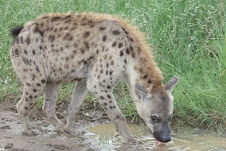
Spotted hyaena are seen and heard regularly and fresh spoor can be seen most days. Nobody has carried out a survey into their numbers or den locations but their numbers are healthy as several images of individuals have been recorded throughout the park.
Although serval have been seen in the past the only image captured was of one individual near the main gate.
Caracal exist in the park but none were recorded during the survey.
Civet exist in large numbers and images have been collected from many locations. Very little is known about these shy illusive creatures other than they are often mistaken for leopard.
Genet have been seen and images recorded and again very little is known about their habits.
Spoor of wild cat can be seen but no images were taken.
Several species of mongooses exist along with what we believed to be a striped weasel.
The information regarding the dogs has already been sent to many conservation groups worldwide and has gained a great deal of interest.
The importance of these painted dogs is very important to the tourist industry of Malawi and I am working with the Department on this issue.
INTRODUCTION
Kasungu National Park is approximately 2,316km² and is situated on Malawi’s western border with Zambia. Kasungu became a National Park in 1970 and was seen as the best game park in Malawi
Wild dog have now been seen and I believe that these are not a pack from Zambia but have always been in the park but due to lack of knowledge and research their presence has been overlooked and nobody believed that they were present in Malawi. I believe that Cheetah are still present in the park but have set up their home ranges away from heavily poached areas. The wild dog is believed to be the second rarest carnivore in Africa with around 3000 left in the wild. Cheetah, although rare and under extreme pressure are quite common in certain countries.
The work carried out on this project is now in its third year.
I first visited many of the National parks in 2007 and this started my interest in the carnivores in these parks.
The main focus has always been wild dog in KNP and in 2007 Jarvis Thamala, the manager of KNP reported that he believed that there could still be wild dog and even cheetah in KNP.
The deterioration of wildlife has been part due to cross-border poaching as well as local poaching. Poaching includes, cutting of fire wood, wire snares and gun poachers. For a separate report on this National Parks holds reports complied the park management annually.
The park has a designated 5km buffer zone on its eastern border and 40 km of electric fence although this has just been increased significantly.
The woodland is mainly brachystegia/julbermardia in the hilly areas with grassy dambo areas that offer good grazing.
The history of the park dates back to 1922, when it was declared a forest reserve, more as an anti-tsetse fly measure than anything else, because no effort was made to develop it until 1963, though it was gazetted as a game reserve in 1930. Since 1963, however, tremendous strides have been made in building suitable and comfortable visitor accommodation creating a large dam and in constructing a well thought-out road system from which animals can be viewed.
Animals now believed absent from the park but which were once resident include, Black Rhinoceros, Cheetah, giraffe and side striped jackal.
The issue
With the growing pressure of poaching, de-forestation and human encroachment into parks and forest reserves in Malawi the need to protect and conserve the existing wildlife also grows. At present there is very little understanding or knowledge in Malawi of numbers and the distribution of large carnivores or indeed many other animal species.
Project goal
At the request of The Director of the Department for National parks and wildlife (DNPW) carry out a pilot survey of African carnivores (and other wildlife populations) and their habitats within Kasungu National Park with particular emphasis on wild dog, cheetah, lion and leopard.
Objectives
- Carry out pilot survey on carnivores using various techniques including motion sensor cameras, road side observations and walking transects.
- Make joint patrols and transects of Kasungu National Park personnel to find and record data on mammal species.
- Train scouts in recognition and distribution of relevant animals, spoor and other signs.
- Increase the national and international importance of Keystone Species of mammals in Malawi.
Back ground
DNPW have a strategy for managing the wild life in Malawi. A pilot study of the wildlife can help with this strategy.
There are many ways to carry out a survey so due to costs and practicality I decided on a pilot survey rather than any other form of in depth survey which would cost a great deal of money and indeed take much longer. This pilot survey is designed to find what species of carnivores and wild life still exist in the game parks and is not designed to give accurate numbers, home ranges, territories or habits of these animals.
High tech cameras are a fairly new invention and can be used to take photographs both at night and during the day. Due to digital storage devices hundreds of photos can be taken in one day and those not required can be deleted easily and very cheaply. In the past film could be used but was very expensive, both to buy and process.
Other methods of looking into population sizes use aerial counts, ground counts, counts of calls, scat, spoor, capture and recognition of individuals. For reasons of cost aeriel counts and capture will not be used but by using a combination of the others identification of animals will be enhanced.
So why is a pilot study necessary?
As I have indicated nobody is really sure or has any photographic evidence of what animals exist in the parks. Many people say they have seen leopard but how much of this is mis-identification. On questioning several people it can be concluded that animals like civet and genet can be mistaken for these larger cats. Photographic evidence cannot be misinterpreted.
All data must be collected on the carnivores which might help towards the study. Change in population size, reproduction rates, emigration and immigration rates and mortality as well feeding habits canal help with the survey and understanding of what is happening to the animals in the park.
It is important to carry out this study to try and estimate the population size and then be able to compare this with historic data to determine the change in the population.
If and when animals are seen, dead or alive, try to see whether they were pregnant or not. This can help to determine the condition of the animal. A sick animal will not breed.
Mortality is important and if at all possible the cause of death should be determined. Did it die of old age, starvation, and predation?
Is there history of emigration or migration of animals to and from the park? This has an effect on numbers.
If carnivores are found at a kill site try and estimate the type of kill, its age, sex and condition and if possible do the same for the carnivore if it is present. Most carnivores are very flexible in what they kill and eat and often adapt to their environment. Most people associate cheetah with wide open spaces where they make their kill however the cheetah is very adaptable and will hunt in woodland. The leopard adapts quickly and can be found in some cities and towns. To find kill sites look for vultures and other birds of prey like eagles and kite, look up trees for leopard kills, smell the air, and listen for calls and sounds of fighting or feeding.
Examine the kill if possible for haemorrhages, different carnivores kill in different ways, look for the condition of the prey and for signs of disease, was it chewing grass at the time of kill, collect skulls for later analysis. Look for other signs, spoor, scat, hair and signs of a struggle. Remember leopard often pluck clumps of hair from the victim before eating them and also try to leave their uneaten prey up a tree out of reach of other carnivores. Try to examine faeces as this can often determine what the animal has been eating. Keep known samples of hair from prey and compare this with samples from scat.
What you need to know about predators and how the information above might help.
· Population size - the effect it has on other species.
· Population dynamics – the structure of the population.
· Feeding – that is the number of species they are eating as well the numbers of each species.
· Movements – how far they are moving and determine home ranges and territories.
· Handling – how to capture for long term research.
· Social organisation – the interactions of individuals and to other species.
Methodology
· Place one or more motion cameras in areas where carnivores are likely to travel through or where they have been reported to be present and capture and record as many images of wildlife as possible. Good practice is to place one camera on each side of the track to gain images of both sides of the animal which helps with identification.
· Use road side surveys to identify spoor and other signs of carnivores. Capture images where possible.
· Carry out walking transects through the bush to identify spoor and other signs of carnivores. Capture images where possible.
· Use ground survey to identify spoor and other signs of carnivores. Capture images where possible.
· Communicate with all known sources of knowledge on all sightings of animals and spoor and record and investigate evidence.
· Record data on the relevant sightings on data sheets.
· Compare images to evaluate where possible the different animals within a species.
Equipment used
Canon EOS400d digital camera.
Sony handy cam video recorder.
6 Bushnell trophy cam motion sensor cameras.
Garmin venture GPS.
Bushnell trophy cam.
This camera is designed for use in the bush and has a hard plastic casing which is water proof. It has a passive infra red motion sensor and infra red flash which is designed not to disturb the wild life when it is taking pictures. It has a set time of 1 second and can be programmed in many ways. You can chose between 3 and 5 Mpixels, high normal or low sensitivity, 1,2 or 3 pictures per settings, large number of timings between reset of camera and times when the camera is operational. It also has a video built in which can be programmed in different ways. There is a 2 Gbyte sd card fitted which allows for around 1,880 frames to be taken. 4 or 8 AA size rechargeable batteries can be fitted. The camera has an operating range of around 15m.
The disadvantages of this type of camera are that the passive infra red sensor detects changes in heat between the back ground and an object which means that if a leaf, branch or grass of a different temperature moves in front of the sensor and is detected then photographs will be taken. The result of this is that you usually get more pictures of nothing rather than the desired pictures of wild life.
The other disadvantage is that if an object is too close to the camera the infra red flash can show up as being too bright and the image is hard to see. On some occasions the wildlife can see the infra red flash and although they are not alarmed by it they are aware of it and in the case of one hyena it actually saw the camera in the dark, tore it from the tree and semi destroyed it.
To process the pictures the sd card is removed from the camera and entered into the sd slot in the computer where pictures are down loaded. These are then saved or deleted as required. The computer has the capacity to enhance photos taken in this way. They can be cropped and enlarged as well as modifying the colour and contrast.
summary of conservation accomplishments.
The main accomplishment of the project was finding and recording many species of wild life in Kasungu National park. The national survey by the DNPW states there are no carnivores in the park however this project can now help the department update its records.
Information regarding the findings from the survey have been widely published nationally and internationally.
Now that wild dogs have been confirmed as living and thriving in Kasungu they now need to be conserved and protected for the future.
Wild life recorded and seen.
Due to the difficulties in sending large amounts of photographs and videos I have not included any in my report, however you can see many of these in my Blog. www.carnivoreconservationmalawi.blogspot.com
Carnivore Images captured
- 25 wild dogs
- 5 leopard
- many hyena
- many civet
- several large spotted genet
- banded mongoose
- water mongoose
- slender mongoose
- lesser bush baby
- 1 striped weasel

(Historic Data collected in 2007 at start of project)


Wild dog (for figures on the wild dog sightings earlier in the year see separate report filed by D.Yearley)
Wild dogs have been reported as being resident in the park for many years however no pictures were taken until 2009 when a picture of 2 dogs was taken. At the same time there were several sightings recorded. Until these sightings the wild dogs were believed to be extinct in KNPand therefore Malawi.
In October 2010 the Central Division manager for the park twice recorded, on video a pack of 17 dogs, 10 pups and 7 adults and a pack of 6 dogs on the main road near the main gate. I believe these to be the same dogs as the video was taken within 2 days of each other and in the same area of the park. Later in November a tourist took pictures of a dog not far from these sighting and believed there were 12 in the area.
On February 11th. 2011 the divisional manager reported that he had just seen 5 dogs, they had been trying to dig a striped weasel out of a hole when they were disturbed and ran off. Later that evening
I went in search of the dogs and found a pack of 9 dogs. I was able to study these for several minutes and took several pictures and videos. The dogs looked well fed and although there was 1 male the sexes of the others was difficult to determine. None of the dogs had radio collars fitted.
I went in search of the dogs and found a pack of 9 dogs. I was able to study these for several minutes and took several pictures and videos. The dogs looked well fed and although there was 1 male the sexes of the others was difficult to determine. None of the dogs had radio collars fitted.
On later analysis none of these dogs could be identified as being the same dogs as seen in October and when pictures were sent to PDC Zambia they could not identify any of these dogs as coming from known dogs in Zambia.
Latter in February I found the lower jaw of a male zebra very close to where the dogs were seen and concluded that the dogs had killed and eaten the zebra. No kill site was found.
Earlier sightings of dogs by villagers near Khalango scout camp were reported of 6 dogs near their village in August 2009.
Scouts in Chipili saw one wild dog chasing hartebeest through their camp in late November 2009. This was described as being quite a dark coloured dog and was quite large which could be the same large dog that saw hunting alone back in May 2009.
It is my belief that the wild dog actually den in the park and probably fairly close to the main gate. No study or transects have been made to try and confirm a den site.


Lion
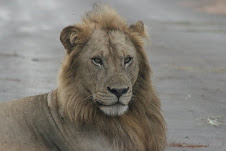
In October 2010 2 sightings of lions were recorded. A pride of 5 lion,1 male, 3 females and a cub were seen close to the main gate. 2 days later in the same area 1 male and 2 females were seen. I assume these were the same pride. No other spoor has been recorded during the survey.
Leopard
People have reported that the park has many leopards and a great deal of people say they see leopard regularly, however I believe that some of these sightings are in fact sightings of other carnivores such as civet and genet. They report that the leopard kill their chickens. Leopards are heard regularly close to the main camp but all attempts to capture an image of this cat failed.
One large male leopard moves between the main camp and the lodge. 5 images of this cat have been captured and analysed and he has 3 defining marks. He has a dark band behind his right ear, a long black mark under his throat and a long black mark on the inside of his left leg. I believe him to be the dominant male in the area.
3 images of 1 leopard have been taken approximately 20 km to the north of the main camp at Miondwe. This looks like a different cat to the one at main camp due to the lack of distinguishing marks and the distance between the 2 sightings.
Day time pictures were taken of a female leopard that returned to her kill of a common duiker.
A young leopard, sex unknown, was recorded on the main road close to the main camp and offices at 1830 hrs.
Several reports from park staff were made of several sightings of leopard, usually close to the main road. Several reported one large leopard and a small one, presumably mother and a cub.
No scat has been found from any of the leopard so no analysis could be carried out. The only definite kill found has been a common duiker.
Cheetah
Cheetah used to seen regularly when certain areas of the park were managed to attract prey species which in turn attracted the cheetah but no sightings have been confirmed for many years. Spoor was seen and scat analysed of what was believed to be cheetah close to the main camp. Pictures of the spoor was shown to experts at the EWT in South Africa and they were confirmed as cheetah. The scat was analysed and hooves of common duiker were found.
Spotted hyena
There have been many sightings of hyena, spoor and photos of hyena throughout the park and they can be heard several times a week near the main camp and lodge. The number is hard to estimate. No pictures of young have been taken but there does seem to be a range of ages and sexes. Many images were gained when the scouts reported a dead warthog near the lower Lingadzi. Photos were taken and I believe at least 3 different individuals visited the kill over 2 nights before the hyena dragged the hog further into the bushes. One hyena was brave enough to rip a camera from the tree it was mounted on and chewed it before dropping it in the bushes close by. This camera has since stopped working. 1 image of a hyaena shows it carrying a kill in its mouth which looks like a common duiker but could be a calf of puku or impala. No den sites have been found and very little is known about these predators.
Serval
In 2007 I saw what I believed to be a serval and in November 2010 the cameras took a picture of a serval near the camp near the main gate. This I believe is often mistaken by the staff as being a leopard.
Caracal
In April 2009 I saw a caracal walking along the fence line near the main gate.
Civet
There are many civets in the park with pictures being taken at most sites were the cameras were placed. No middens have been found so analysis of their eating habits cannot be studied however they are known to eat waste food thrown out in the rubbish.
Spoor is regularly seen all around the park.
Large spotted genet
This is identified from the lesser spotted genet by having a black tip to the tail whereas the lesser spotted genet has a white tip to the tail.
This has been caught on camera in the garden at the house and along the upper Lingadzi. Spoor is seen regularly around the park.
Slender mongoose
Many images of this illusive creature have been captured with it drinking water in the garden of the house. Number and sex unknown but it believed to be the same animal in each case.
Water mongoose
After several weeks of seeing the spoor of this creature I managed to get a picture of one in the river bed along the upper Lingadzi.
Mongoose
Banded mongoose and dwarf mongoose have been seen.
Bush baby
Several images of a lesser bush baby have been captured in the garden and one when it appeared to being stalked by a snake.
Primates
Baboons and monkeys are seen frequently around the park.
Images captured of other species
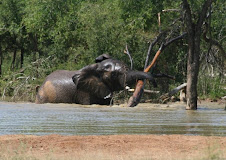
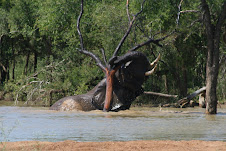
· elephant
· buffalo
· hippo
· roan
· sable
· zebra
· Lichtenstein’s hartebeest
· wart hog
· bush pig
· elephant shrew
· puku
· impala
· reed buck
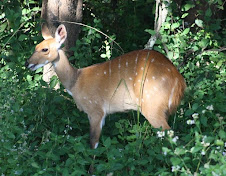
· bush buck
· kudu
· Sharpe’s grysbok
· water buck
· common duiker
· vervet monkey
· yellow baboon
· various bats
Reptiles images
· black mamba
· Mozambique spitting cobra
· Bush snake
· Brown house snake
· Python
· Lizards
· geckos
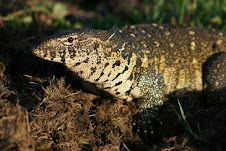
· water monitor lizard
Bird’s images captured
· striped cuckoo
· weavers
· spectacled weaver
· black eyed bulbul
· swamp boubou
· red throated twinspot
· blue waxbill
· grey lourie
· purple crested lourie
· arrow mark babler
· black fly catcher
· paradise flycatcher
· pin tailed wydah
· cape turtle dove
· emerald spotted dove
· laughing dove
· greater blue eared glossy starling
· Jameson’s fire finch
· heuglin robin
· melba finch
· plum coloured starling
· pied crow
· pygmy kingfisher
· southern black tit
· sun birds
· kurichane thrush
· blue grey flycatcher
· Barn owl
· barred owl
· giant eagle owl
· saddle billed stork
· open billed stork
· red crested korhaan
· grey heron
· goliath heron
· African fish eagle
· Hamerkop
· Spurwinged goose
· Little banded goshawk
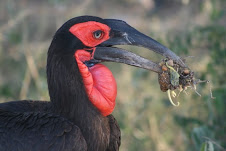
· Ground hornbill
· Pied wagtail
· Scarlet crested sunbird
· Egrets
Many other species of birds were seen but no images captured such as:
· Fork tailed drongo
· White winged tern
· White faced duck
· Yellow billed duck
· Knob billed duck
· African jacana
· Lesser jacana
· Crowned plover
· Wattled plover
· Blacksmith plover
· helmeted guinea fowl
· bateleur
· brown snake eagle
· martial eagle
· green pigeon
· pennant winged nightjar
· swallows and swifts
· giant kingfisher
· pied kingfisher
· hoopoe
· scimitar billed wood hoopoe
· yellow billed hornbill
· red billed hornbill
· grey hornbill
· ground hornbill
· black collared barbet
· oxpecker
· red bishop
· golden bishop
· Burchell’s coucal
Conclusion
The survey has taken place between September 2010 and the beginning of March 2011 in Kasungu National Park.
Limiting factors to the success of this project included:
· No fuel in the country for 5 weeks to run the land rover. It was difficult to get to scout camps while this was happening.
The weather condition and some dambos were too difficult to cross to get to camps and carry out transects.
The weather condition and some dambos were too difficult to cross to get to camps and carry out transects.
· Difficulty in scouts being able to report sightings of carnivores to me by phone due to poor reception.
The cameras have been placed in the bush for a total of around 5,500hrs and have captured in the region of 30,000 images. Not all of these contained images of wildlife. I have not kept records of actual percentages of effective image captures as I am not reporting on the effectiveness of the cameras although I will investigate the use of other cameras in the future because I see that passive infra red cameras have disadvantages as well advantages.
The main disadvantages being:
· If the animal is moving quickly the image on video is very short and if stills are being taken only some of the animal is seen.
· That they operate when they see things like grass and leaves moving.
· At night the images can be too bright if the subject is too close.
· The image at night is black and white and not colour.
Other than the camera that was attacked by the hyena all the other cameras are still working and appear to be quite effective even in the rain and wet conditions.
The cameras are very good at picking up small images like birds as well as elephant.
When I started this survey there were reports from many sources that there were lots of leopard and lions all over the park. However from the photographic survey, so far, we can conclude that there are definitely 5 leopards. There are more spread through the park and these often visit the scout camps. Actual numbers remain unknown. From answers I get about wildlife identification from staff I also believe that other animals like genet and civet are mistaken by people as being leopard and this is clear because when asking people to identify pictures they say that genet and civet are leopard.
The lion population in the park appears to be very low. Spoor has been seen around the park on several occasions and they are heard occasionally. There have been no reports from outside the park regarding them causing problems. When it comes down to the prey for lion there seems to be several good herds of buffalo as well as a few zebra, eland and kudu but their herds are wide spread. Every time I saw a herd of buffalo I was hoping to see evidence of lion. This did not happen. To my knowledge scouts have never found a lion kill.
As for other large carnivores spotted hyena seem to be everywhere in the park and are often seen and heard. I am not aware of where their dens are. From their images and spoor it can be concluded that there are many mature hyena as well as some juvenile hyena. Very little is known about these creatures.
I have seen both serval and caracal in the park and have only 1 image of 1 serval close to the main gate. Their numbers and distribution are unknown.
Many civets have been captured on camera and their spoor can be seen in various locations around the park. Some individuals have been identified but their home ranges and distribution has not been established although I believe their numbers to be healthy.
Large spotted Genet images have been captured in several locations throughout the park and I believe their numbers to be healthy.
Recommendations for future actions
It is proving very difficult to raise funds for this project and several applications have already been turned down by M.E.E.T, The Beit Trust, National Geographic large cat survey and the Rufford Foundation. Many donors will not consider giving grants to small organisations and individuals or non charity linked associations. However it is often the small organisations that really add to conservation more so than well established groups that are not contributing as much as they used to as most research has already been covered. If the money can be found I would recommend:
· We continue with the survey of the wildlife in Kasungu National park and in particular the search for large carnivores including the cheetah.
· Now that we have established that there are at least 2 packs of dogs in the park it is even more important to conserve and protect them. Money needs to be raised to give the PWAs (scouts) refresher training in anti poaching and conservation of the parks ecology.
· Local communities need to be sensitised about the importance of conservation of the wild life and wild dogs.
· If you do not know where the dogs are then you cannot protect them therefore it is very important to raise money to collar at least 2 dogs in the park so that their movements can be monitored which will help with their protection.
Training and outreach activities
Although there were no official training plans carried out during this phase of the project, mainly due to lack of funds, many people in and around the park including some graduate trainees from a Malawian University, several wild life clubs, park management and staff and tourists have been sensitised to the project and its objectives.
An anti poaching board and carnivore detail sheets have been placed at the main gate to inform people of the project and its objectives.
National and international awareness
Wild dog are one of the most endangered species of wild life in Africa and it has been very important to communicate the fact that these creatures are alive and well in a country where in the past wild dogs were believed to be extinct. The finding of these dogs should be of significant importance to the Malawi government and tourism, conservation groups and research institutions. The Government can use the fact that there are wild dogs to increase the tourist trade to Malawi and should look at this as being a major attraction for international tourists.
These facts have been published on my web site and blog (www.carnivoreconservationmalawi.org)where the facts can be seen by everyone in the world on the internet.
I have also contacted:
The Malawi government.
Malawi tourist board.
High commission for Malawi in the UK.
Oxford university.
Bristol University.
PDC Zimbabwe.
PDC Zambia.
EWT South Africa.
MEET
WESM (Wildlife and environmental Society of Malawi)
ESOM (Endangered Species of Malawi)
Dr Gianetta (Netty) Purchase - Coordinator - Regional cheetah conservation strategy
ZSL/WCS
IFAW
IUCN
The Rufford Foundation
Perth Zoo
Taronga Zoo
ZSL
Tembe elephant park
And many more organisations.



.jpg)